3×
More Potent
vs native IGF-1
⚠️ FOR RESEARCH PURPOSES ONLY — This compound is not FDA approved. All data presented is from clinical trials for educational reference.
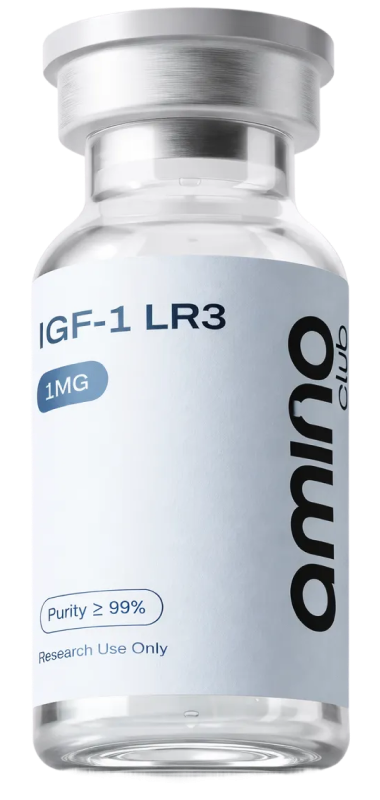
Growth Factor Analog Peptide
An 83-amino acid synthetic analog of human insulin-like growth factor 1 with reduced binding protein affinity and extended half-life, studied for anabolic and tissue growth effects in preclinical research. Premium Research Peptide.
3×
More Potent
vs native IGF-1
20-30hrs
Half-life
vs 12-15 hrs native
Low
IGFBP Affinity
Bypasses binding proteins
83AA
Amino Acids
vs 70 for native IGF-1
2.5×
Anabolic Effect
Anti-catabolic potency
IGF-1 LR3 is a synthetic analog of human insulin-like growth factor 1 with two key modifications: an arginine substitution at position 3 (instead of glutamic acid) and an additional 13 amino acids at the N-terminus. These changes reduce binding to IGF-binding proteins (IGFBPs) while maintaining full agonist activity at the IGF-1 receptor, resulting in enhanced potency and prolonged half-life.
Insulin-like Growth Factor 1 Receptor
Activates PI3K/Akt signaling
Stimulates mTOR pathway
Promotes protein synthesis
Insulin-like Growth Factor Binding Proteins
Bypasses sequestration by binding proteins
Increased free/bioactive fraction
Extended duration of action
Protein Kinase B / Mammalian Target of Rapamycin
Protein synthesis activation
Cell proliferation and growth
Anti-apoptotic signaling
Native IGF-1 is rapidly sequestered by six different IGF-binding proteins (IGFBP-1 through 6), which regulate its bioavailability. The 13-amino acid N-terminal extension in IGF-1 LR3 dramatically reduces this binding, allowing more free peptide to reach target tissues.
Result: IGF-1 LR3 retains full pharmacological activity at the IGF-1 receptor while having very low affinity for IGFBPs. This translates to approximately 3-fold greater potency and a half-life of 20-30 hours (vs 12-15 hours for native IGF-1).
In circulation, IGFBPs bind and sequester native IGF-1, limiting its bioavailability. LR3 modification allows the peptide to bypass this regulation.
Clinical significance: Because IGF-1 LR3 is not sequestered by binding proteins, a greater proportion of the administered dose remains bioactive. This is why it demonstrates 2.5-3× greater potency in preclinical models despite binding to the IGF-1 receptor with similar affinity.
Summary of preclinical findings
More Potent Than Native IGF-1 (Anabolic Effects)
Key findings: In dexamethasone-induced catabolic rats, IGF-1 LR3 was approximately 2.5-fold more potent than native IGF-1 in reversing weight loss and preserving nitrogen balance. The highest dose produced a 6g increase in body weight over 7 days, compared to a 19g loss in untreated controls.
Data from rat model studies
Important context: All studies to date have been preclinical (animal models). No human clinical trials have been conducted with IGF-1 LR3. Results in humans may differ significantly from animal studies.
Note: Values are relative to native IGF-1 (100%). Lower IGFBP binding is advantageous as it means more free/bioactive peptide.
Areas of preclinical investigation
Anti-catabolic potency vs IGF-1
Tomas et al., 199220-30 hours duration
von der Thüsen et al., 2011Increased bioavailability
Mohan & Baylink, 2002Retained IGF-1R agonism
Tomas et al., 1996IGF-1 LR3 has been studied for its effects on muscle protein metabolism, showing coordinate effects on both protein synthesis and breakdown.
Research finding: In catabolic rat models, IGF-1 LR3 reduced 3-methylhistidine excretion (a marker of muscle protein breakdown) by approximately 3-fold more than native IGF-1.
IGF-1 LR3 demonstrates pronounced effects on visceral organ growth, particularly the gastrointestinal tract.
Recent studies have explored intranasal IGF-1 LR3 for cognitive applications in animal models.
Area of research
Emerging research: Intranasal LR3-IGF-1 administration has been studied for its potential to delay cognitive decline in animal models, leveraging the peptide's enhanced bioavailability.
IGF-1 LR3 has shown particular promise in reversing glucocorticoid-induced catabolism in animal models.
What preclinical studies report
Safety data for IGF-1 LR3 is limited to preclinical animal studies. No human safety data exists. The following information is extrapolated from native IGF-1 research and animal model observations.
Because IGF-1 LR3 is 2.5-3× more potent than native IGF-1, all potential effects may be amplified:
No human clinical safety data exists
Animal studies did not report significant adverse events at tested doses
Long-term effects are unknown
WADA Prohibited Substance — banned in competitive sports
Not approved by FDA for any indication
No regulatory approval in any jurisdiction
Research compound only — not for human consumption
Technical specifications
Common questions about IGF-1 LR3 research
IGF-1 LR3 differs from native IGF-1 in two key ways: it has an arginine instead of glutamic acid at position 3, and it has an additional 13 amino acids (MFPAMPLLSLFVN) at the N-terminus, for a total of 83 amino acids versus 70 for native IGF-1. These modifications dramatically reduce binding to the six IGF-binding proteins (IGFBPs) while maintaining full agonist activity at the IGF-1 receptor. The result is approximately 3-fold greater potency and an extended half-life of 20-30 hours (vs 12-15 hours for native IGF-1).
In circulation, IGFBPs bind and sequester native IGF-1, limiting the amount of free/bioactive peptide available to activate IGF-1 receptors. By reducing IGFBP binding, IGF-1 LR3 remains bioactive longer and a greater proportion of the administered dose reaches target tissues. Studies show that continuous infusion of IGF-1 LR3 was 1.5-2 fold more potent than native IGF-1 for effects on body weight, organ weights, and feed efficiency in animal models.
No. All available research on IGF-1 LR3 comes from preclinical animal studies, primarily in rats. No human clinical trials have been conducted to establish safety, efficacy, or appropriate dosing in humans. The compound remains strictly a research tool and is not approved for human use by any regulatory agency.
In dexamethasone-induced catabolic rats, IGF-1 LR3 was approximately 2.5-fold more potent than native IGF-1 in reversing weight loss and preserving nitrogen balance. The highest dose produced a 6g body weight increase over 7 days (compared to 19g loss in untreated controls). It also increased gut weight by up to 45% and reduced 3-methylhistidine excretion (a protein breakdown marker) by 3-fold more than native IGF-1.
Yes. IGF-1 LR3 is listed on the World Anti-Doping Agency (WADA) Prohibited List under category S2 (Peptide Hormones, Growth Factors, Related Substances, and Mimetics). It is prohibited both in-competition and out-of-competition in all sports. Athletes subject to drug testing should be aware that use of this compound will result in a positive test and potential sanctions.
Like most peptides, IGF-1 LR3 in lyophilized (powder) form should be stored at 2-8°C (refrigerated) or -20°C (frozen) for long-term storage. Once reconstituted with bacteriostatic water, it should be kept refrigerated and used within 2-4 weeks. Avoid repeated freeze-thaw cycles and protect from light.
While human safety data is lacking, potential risks based on IGF-1 biology and animal observations include: hypoglycemia (low blood sugar due to insulin-like effects), organ hypertrophy (particularly gut, spleen, kidneys), fluid retention, and theoretical concerns about promoting cancer cell growth. Because IGF-1 LR3 is 2.5-3× more potent than native IGF-1, these effects may be amplified. No long-term safety data exists.
Peer-reviewed research
Tomas FM, Knowles SE, Owens PC et al.
Tomas FM, Lemmey AB, Read LC, Ballard FJ
Mohan S, Baylink DJ
von der Thüsen JH, Borensztajn KS, Moimas S et al.
Conlon MA, Tomas FM, Owens PC et al.
Not for human consumption. This product is sold exclusively for research and educational purposes. It is not intended to diagnose, treat, cure, or prevent any disease.
All clinical trial data and research findings presented on this page are sourced from peer-reviewed journals and official publications. They are provided for educational reference only and should not be interpreted as medical advice or product claims.
By purchasing this product, you confirm that you are a qualified researcher and will use it in accordance with all applicable laws and regulations.