10.8%
Weight Loss
Phase 2, 26 weeks, 4.5mg
⚠️ FOR RESEARCH PURPOSES ONLY — This compound is not FDA approved. All data presented is from clinical trials for educational reference.
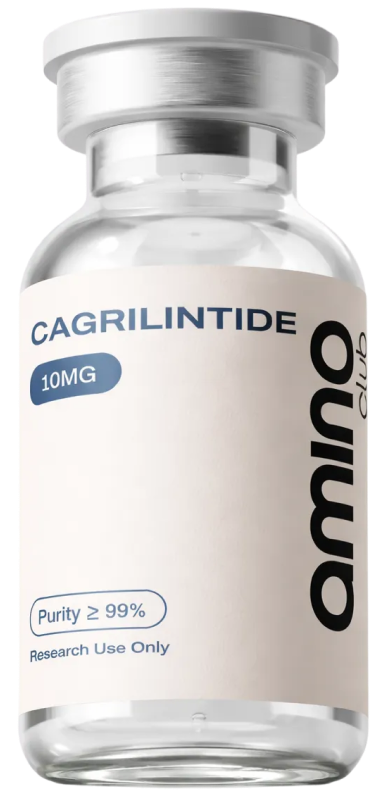
Metabolic Research Peptide
A 37-amino acid long-acting acylated amylin analog that activates amylin and calcitonin receptors to modulate appetite signaling in homeostatic and hedonic brain regions, studied in clinical trials for weight management. Premium Research Peptide.
10.8%
Weight Loss
Phase 2, 26 weeks, 4.5mg
20.4%
With Semaglutide
CagriSema, REDEFINE 1
~7days
Half-Life
Once-weekly dosing
2
Receptor Targets
Amylin + Calcitonin
3,400+
Trial Participants
REDEFINE 1 alone
Unlike GLP-1 drugs such as semaglutide (Ozempic/Wegovy), cagrilintide works through the amylin pathway — a completely different appetite regulation system. Amylin is naturally co-secreted with insulin from pancreatic beta cells after meals, signaling fullness via both the homeostatic and hedonic (reward) centers of the brain.
Amylin Receptors 1 and 3
Reduces appetite via hypothalamus signaling
Delays gastric emptying
Suppresses postprandial glucagon secretion
Calcitonin G Protein-Coupled Receptor
Modulates hedonic (reward) appetite centers
Contributes to satiety signaling
Complements amylin receptor activity
While GLP-1 drugs target one satiety pathway, cagrilintide works through the amylin system — a separate, complementary mechanism. This is why combining cagrilintide with semaglutide (CagriSema) produces greater weight loss than either compound alone.
Key insight: In the REDEFINE 1 trial, adding cagrilintide to semaglutide produced 5.5% additional weight loss beyond semaglutide alone (20.4% vs 14.9%), confirming the pathways are truly complementary.
Cagrilintide's amylin-like action uniquely targets both the homeostatic system (hypothalamus — controlling hunger/fullness signals) and the hedonic system (reward centers — controlling cravings and food-seeking behavior). This dual action addresses two of the primary drivers of overeating.
Phase 2 and Phase 3 clinical trial data
Weight Loss with CagriSema (68 weeks)
Trial details: 3,417 adults with overweight or obesity (BMI ≥30 or ≥27 with comorbidities) • 68 weeks • 22 countries • Published NEJM 2025
How CagriSema performed against placebo at 68 weeks
For context: 5% weight loss is considered clinically meaningful. Over 90% of CagriSema participants exceeded this threshold.
Note: Comparisons are from separate trials with different populations. Direct head-to-head data would be needed for definitive conclusions.
Weight loss at 26 weeks across cagrilintide monotherapy doses
Additional outcomes observed in clinical trials
CagriSema significantly reduced waist circumference compared to placebo in REDEFINE 1
NEJM — REDEFINE 1Clinically meaningful blood pressure improvement with CagriSema treatment
NEJM — REDEFINE 1Superior HbA1c reduction with CagriSema vs semaglutide alone in REIMAGINE 2
Novo Nordisk — REIMAGINE 2Significant improvements in physical functioning quality of life scores (IWQOL-Lite-CT and SF-36)
NEJM — REDEFINE 1Cagrilintide uniquely targets both homeostatic hunger signals (hypothalamus) and hedonic food-reward pathways (hindbrain, septum). This dual action may explain why it enhances weight loss when combined with GLP-1 agonists.
Additional weight loss vs semaglutide alone
Clinical significance: The complementary mechanism means cagrilintide addresses appetite drivers that GLP-1 agonists alone do not fully reach.
In the REIMAGINE 2 trial, CagriSema demonstrated superior HbA1c reduction and weight loss compared to semaglutide alone in patients with type 2 diabetes.
No plateau: No weight loss plateau was observed with CagriSema at the end of the 68-week trial.
REDEFINE 1 demonstrated improvements in cardiovascular risk markers with CagriSema treatment, including significant reductions in waist circumference and systolic blood pressure.
What researchers reported across clinical trials
The most commonly reported adverse events with cagrilintide are gastrointestinal, consistent with other incretin- and amylin-based therapies. Most events were mild-to-moderate in severity and diminished over time.
Most discontinuations occurred during dose escalation phase
Gastrointestinal events were the primary reason for discontinuation
The combination had higher discontinuation than either monotherapy
Long-term safety data beyond 68 weeks is still being collected
As with all amylin-based therapies, pancreatic safety is monitored
Combination use with other metabolic agents requires careful evaluation
Cagrilintide is investigational — full safety profile not yet established
Technical specifications
Common questions about cagrilintide research
Cagrilintide is a long-acting synthetic analog of amylin, a hormone naturally co-secreted with insulin from pancreatic beta cells. Unlike GLP-1 receptor agonists such as semaglutide (Ozempic/Wegovy), cagrilintide works through the amylin and calcitonin receptor pathways. It targets both homeostatic (hunger/fullness) and hedonic (food reward/craving) appetite centers in the brain, providing a complementary mechanism to GLP-1 drugs.
In a Phase 2 trial, cagrilintide monotherapy at 4.5mg achieved 10.8% weight loss over 26 weeks. In the Phase 3 REDEFINE 1 trial, cagrilintide alone (2.4mg) produced 11.5% weight loss at 68 weeks. When combined with semaglutide (as CagriSema), weight loss reached 20.4% at 68 weeks — a 5.5% improvement over semaglutide alone (14.9%). Over 90% of CagriSema participants achieved clinically meaningful weight loss (≥5%).
CagriSema is a fixed-dose combination of cagrilintide (an amylin analog) and semaglutide (a GLP-1 receptor agonist) being developed by Novo Nordisk. It combines two complementary appetite regulation pathways in a single once-weekly injection. CagriSema was submitted to the FDA for weight management in December 2025 based on the REDEFINE 1 and REDEFINE 2 Phase 3 trial results.
The most common side effects are gastrointestinal: nausea, constipation, diarrhea, and vomiting. These are consistent with other amylin- and GLP-1-based therapies, were mostly mild-to-moderate in severity, and typically diminished over time. In REDEFINE 1, the discontinuation rate due to adverse events was 5.9% for CagriSema compared to 2.6% for placebo. Cagrilintide monotherapy had lower GI event rates than the combination.
Cagrilintide is administered as a once-weekly subcutaneous injection. Its long half-life of approximately 7-8 days (159-195 hours) enables this convenient dosing schedule. In clinical trials, treatment was started at a low dose (0.25mg) and gradually escalated over several weeks to the target dose of 2.4mg to minimize gastrointestinal side effects.
No, cagrilintide is not yet approved by any regulatory authority. It is an investigational compound currently in Phase 3 clinical trials. Novo Nordisk submitted CagriSema (cagrilintide + semaglutide combination) to the FDA for weight management in December 2025. The company is also conducting additional trials (REIMAGINE program) in type 2 diabetes before approaching regulators for that indication.
As a research peptide in lyophilized form, cagrilintide should be stored at -20°C for long-term storage. Once reconstituted, it should be kept refrigerated at 2-8°C and used promptly. It should be protected from light and repeated freeze-thaw cycles should be avoided to maintain stability.
Peer-reviewed research
Garvey WT, Blüher M, Osorto Contreras CK et al.
Lau DCW et al.
Enebo LB et al.
D'Ascanio AM, Mullally JA, Frishman WH
Not for human consumption. This product is sold exclusively for research and educational purposes. It is not intended to diagnose, treat, cure, or prevent any disease.
All clinical trial data and research findings presented on this page are sourced from peer-reviewed journals and official publications. They are provided for educational reference only and should not be interpreted as medical advice or product claims.
By purchasing this product, you confirm that you are a qualified researcher and will use it in accordance with all applicable laws and regulations.