54×
GH Increase
Combined vs baseline
⚠️ FOR RESEARCH PURPOSES ONLY — This compound is not FDA approved. All data presented is from clinical trials for educational reference.
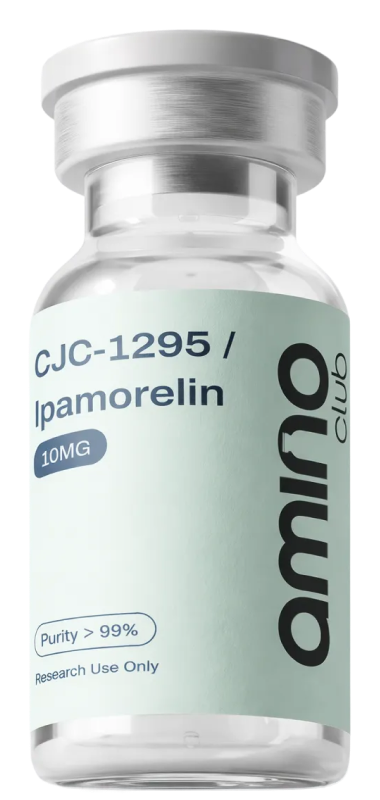
Growth Hormone Secretagogue Peptide
A strategic peptide combination engineered to enhance gh release through synchronized GHRH and ghrelin receptor activation in experimental research models. Premium Research Peptide.
54×
GH Increase
Combined vs baseline
2.7×
Synergy Factor
GHRH + GHRP combined
Selective
GH Release
No cortisol/prolactin spike
30-120min
Half-life
CJC-1295 No DAC
Pulsatile
GH Pattern
Physiologic release
This blend combines two complementary growth hormone secretagogues that work through different pathways. CJC-1295 (No DAC) is a GHRH analog that stimulates the GHRH receptor, while Ipamorelin is a selective ghrelin receptor agonist. Together, they produce a synergistic GH release that exceeds what either peptide achieves alone.
Growth Hormone Releasing Hormone Receptor
Stimulates somatotroph cells
Initiates GH synthesis and release
Activates cAMP signaling cascade
Growth Hormone Secretagogue Receptor Type 1a
Amplifies GH release
Selective activation (no cortisol/prolactin)
Sensitizes pituitary to GHRH
Insulin-like Growth Factor 1
Elevated by sustained GH release
Promotes tissue growth and repair
Mediates anabolic effects
GHRH and GHRP peptides activate different receptor systems that converge on the pituitary somatotroph cell. When combined, they produce a synergistic effect — the whole is greater than the sum of its parts.
Synergy demonstrated: Studies show GHRH alone produces ~20-fold GH increase, GHRP-2 alone ~47-fold, but the combination yields ~54-fold increase — with 43% faster time to peak GH levels.
Ipamorelin is the first truly selective growth hormone secretagogue. Unlike older GHRPs (GHRP-2, GHRP-6, hexarelin), it does not significantly raise cortisol, ACTH, or prolactin levels.
Clinical significance: This selectivity means fewer side effects like increased appetite, water retention, and stress hormone elevation that occur with non-selective GHRPs.
Summary of clinical and preclinical findings
Peak GH Increase (Combined GHRH + GHRP)
Key findings: CJC-1295 (without DAC) produced dose-dependent GH increases of 2-10 fold and sustained IGF-1 elevation of 1.5-3 fold for 9-11 days in healthy adults. Ipamorelin selectively releases GH without affecting cortisol, prolactin, or aldosterone at GH-releasing doses.
Data from Phase I/II clinical trials
Important context: The combination has been extensively studied for its synergistic GH-releasing effects. CJC-1295 without DAC maintains pulsatile release patterns, while Ipamorelin provides selective amplification.
Note: Results based on clinical trials in healthy adults. Individual responses may vary. The 'No DAC' version has shorter duration but more physiologic pulsatile release.
Research-supported benefits of GH secretagogue therapy
Peak elevation after CJC-1295
Teichman et al., 2006Time to max GH (combined)
Bowers et al., 1991Physiologic release maintained
Teichman et al., 2006Safe in clinical trials
Raun et al., 1998GH secretagogue therapy promotes favorable changes in body composition through increased lipolysis and protein synthesis.
Research finding: GH and IGF-1 elevation promotes anabolic processes while enhancing fat oxidation. The pulsatile pattern from No DAC formulations mimics natural physiology more closely.
Elevated GH and IGF-1 accelerate recovery from injury and intense physical activity by promoting cellular regeneration.
GH secretagogues taken before bed enhance slow-wave sleep, the most restorative phase of the sleep cycle.
Slow-wave sleep duration
Clinical correlation: Natural GH secretion peaks during deep sleep. Evening dosing of GH secretagogues amplifies this physiologic pattern, improving sleep quality and recovery.
GH secretion decreases approximately 14% per decade after age 30. Secretagogue therapy can restore more youthful GH patterns.
From clinical trials and research protocols
CJC-1295 (No DAC) and Ipamorelin are typically dosed together via subcutaneous injection. The No DAC version allows for pulsatile dosing that mimics natural GH secretion patterns.
Most common research protocol for the blend
100-300 mcg each
1-3× daily SubQ
Pre-bed most common
100 mcg CJC + 100 mcg Ipa
Combined injection
Lower dose start
Subcutaneous injection, typically abdominal
Best administered on empty stomach
Evening/pre-bed dosing most common
Can dose 2-3× daily for enhanced effect
From Phase II clinical trial in healthy adults
30-60 mcg/kg
Single SubQ injection
Phase II trial doses
Sustained IGF-1
Post single dose
Duration of effect
Doses of 30-60 mcg/kg were safe and well-tolerated
Effects persisted for 9-11 days post-injection
GH increases were dose-dependent (2-10 fold)
No serious adverse events at these doses
No DAC version allows multiple daily doses without receptor desensitization
DAC version has 5.8-8.1 day half-life (sustained, less physiologic)
Combination with Ipamorelin accelerates time to peak GH by ~43%
Evening dosing enhances natural nocturnal GH surge
What clinical and preclinical studies report
Both CJC-1295 and Ipamorelin demonstrated favorable safety profiles in clinical trials. Ipamorelin is notable for its selectivity — it does not significantly elevate cortisol, ACTH, or prolactin.
Unlike other GHRPs, Ipamorelin does not significantly elevate:
No serious adverse events (SAEs) in clinical trials
No withdrawal syndrome reported with discontinuation
Effects are reversible upon cessation
Long-term effects of sustained GH elevation unknown
Potential interaction with glucose metabolism in diabetics
Theoretical risk in those with cancer predisposition
Technical specifications
Common questions about CJC-1295/Ipamorelin research
CJC-1295 'with DAC' (Drug Affinity Complex) has a half-life of 5.8-8.1 days due to albumin binding, providing sustained GH elevation. CJC-1295 'without DAC' (also called Mod GRF 1-29) has a half-life of only 30 minutes to 2 hours, allowing for pulsatile GH release that more closely mimics natural physiology. The No DAC version is generally preferred because it preserves the body's natural GH secretion pattern and allows for multiple daily doses without receptor desensitization.
CJC-1295 and Ipamorelin work through complementary pathways. CJC-1295 is a GHRH analog that stimulates the GHRH receptor on pituitary somatotrophs, while Ipamorelin is a ghrelin receptor agonist that amplifies GH release through the GHSR-1a receptor. Research shows that combining GHRH and GHRP peptides produces synergistic effects — approximately 2.7 times greater GH release than either pathway alone, with 43% faster time to peak levels.
Ipamorelin is the first truly selective growth hormone secretagogue. Unlike GHRP-2, GHRP-6, and hexarelin, Ipamorelin releases GH without significantly elevating cortisol, ACTH, prolactin, or aldosterone at GH-releasing doses. This selectivity means fewer side effects — no increased appetite (unlike GHRP-6), no stress hormone elevation (unlike GHRP-2), and no water retention. This makes it the preferred GHRP component for combination therapy.
Research protocols typically recommend administration on an empty stomach (at least 2 hours after eating) to maximize GH release. The most common timing is before bed to amplify the natural nocturnal GH surge that occurs during deep sleep. Some protocols use 2-3 doses per day (morning, post-workout, and bedtime) for enhanced effects. Food, especially carbohydrates and fats, can blunt the GH response.
In Phase II trials, CJC-1295 produced dose-dependent GH increases of 2-10 fold and sustained IGF-1 elevation of 1.5-3 fold lasting 9-11 days after a single injection in healthy adults. Doses of 30-60 mcg/kg were safe and well-tolerated with no serious adverse events. Ipamorelin trials confirmed its selective GH-releasing action without cortisol, prolactin, or aldosterone elevation at therapeutic doses.
CJC-1295/Ipamorelin stimulates your own pituitary to release GH, maintaining natural pulsatile patterns and feedback mechanisms. Synthetic HGH provides a constant exogenous dose that can suppress natural production. Secretagogues generally have a better safety profile, lower cost, and preserve physiologic regulation. However, they require a functioning pituitary gland and may produce less dramatic effects than supraphysiologic HGH doses.
GH secretagogues may interact with glucose metabolism, potentially affecting blood sugar control in diabetics. They should be used cautiously with insulin or oral hypoglycemic agents. Glucocorticoids (like prednisone) can blunt GH release. Somatostatin analogs (like octreotide) will antagonize the effects. There are no known dangerous interactions, but concurrent use with any GH-affecting medication should be discussed with a healthcare provider.
Peer-reviewed research
Teichman SL, Neale A, Lawrence B et al.
Raun K, Hansen BS, Johansen NL et al.
Bowers CY, Reynolds GA, Durham D et al.
Sigalos JT, Pastuszak AW
Svensson J, Ohlsson C, Jansson JO et al.
Alba M, Fintini D, Sagazio A et al.
Not for human consumption. This product is sold exclusively for research and educational purposes. It is not intended to diagnose, treat, cure, or prevent any disease.
All clinical trial data and research findings presented on this page are sourced from peer-reviewed journals and official publications. They are provided for educational reference only and should not be interpreted as medical advice or product claims.
By purchasing this product, you confirm that you are a qualified researcher and will use it in accordance with all applicable laws and regulations.