61%
Faster Re-epithelialization
vs controls at 7 days in rat wound model
⚠️ FOR RESEARCH PURPOSES ONLY — This compound is not FDA approved. All data presented is from clinical trials for educational reference.
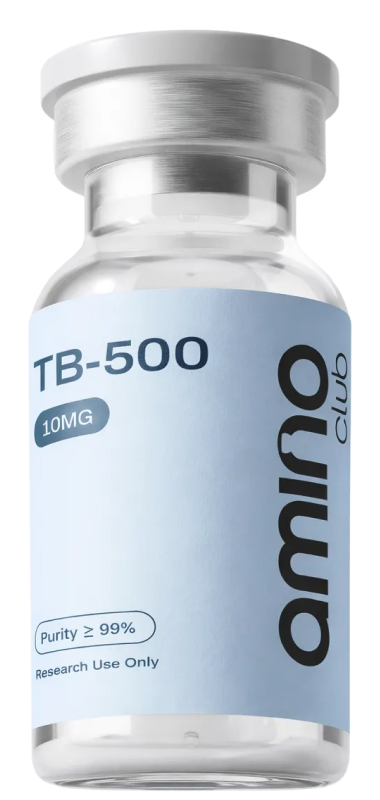
Regenerative Peptide
A 43-amino acid synthetic fragment of thymosin beta-4 that regulates actin polymerization and promotes cell migration in preclinical research. Premium Research Peptide.
61%
Faster Re-epithelialization
vs controls at 7 days in rat wound model
No
Serious Adverse Events
Phase 1 trial with 42-1260mg IV doses
170+
Cited Studies
Goldstein et al. review cited 170+ times
43
Amino Acids
Naturally occurring peptide sequence
0.95-1.9hrs
Half-Life
Dose-dependent (42-1260mg IV)
Thymosin Beta-4 (TB-500) is a naturally occurring 43-amino acid peptide that plays a vital role in tissue repair and regeneration. It sequesters G-actin monomers, promotes cell migration, inhibits inflammation, and stimulates angiogenesis — creating optimal conditions for healing after injury.
Monomeric Globular Actin Binding
Regulates actin polymerization
Enables cytoskeletal remodeling
Facilitates cell motility and migration
ILK/PINCH/Parvin Complex Activation
Promotes cell survival signaling
Activates Akt pathway
Supports cardiac cell migration
NF-κB and Toll-like Receptor Modulation
Reduces inflammatory cytokines
Ameliorates inflammatory damage
Activates pro-resolving pathways
TB-500 binds to G-actin monomers, preventing premature polymerization and allowing coordinated cytoskeletal remodeling. This promotes efficient cell migration to injury sites — a critical step in wound healing and tissue regeneration.
J Invest Dermatol (1999): Thymosin Beta-4 stimulated keratinocyte migration 2-3 fold over controls when as little as 10 pg was added to the assay.
TB-500 ameliorates inflammatory damage by regulating NF-κB and Toll-like receptor pathways. During tissue repair, it activates PI3K/Akt/eNOS and Notch signaling pathways, reducing inflammation while promoting regeneration.
PMC (2021): Tβ4 ameliorates inflammatory damage by regulating NF-κB and Toll-like receptor pathways. During tissue repair, Tβ4 regulates PI3K/Akt/eNOS and Notch pathways.
Summary of clinical and preclinical findings
Serious Adverse Events (42-1260mg IV, 14 days)
Key finding: A randomized, placebo-controlled Phase 1 trial demonstrated that IV Tβ4 at doses of 42-1260mg for 14 days was well tolerated with no dose-limiting toxicities in healthy volunteers (Ruff et al., 2010).
Summary of findings from peer-reviewed studies:
Important: Most wound healing evidence comes from preclinical (animal) studies. Human Phase 1 data confirms safety but efficacy trials are ongoing. FDA approval has not been granted.
Dose response: The study demonstrated a ceiling effect at 18 mg/kg, with calculated optimal dose of 3.75 mg/kg for neurological functional recovery.
Improvement in wound healing markers (rat full-thickness wound model):
Areas studied in preclinical and clinical research
61% faster re-epithelialization at 7 days
J Invest DermatolActivates ILK, promotes cardiomyocyte survival
Nature (2004)Improved functional outcome in stroke and TBI models
J Neurol SciPhase 2 trials for dry eye disease
Clin OphthalmolPreclinical studies show significant cardioprotective effects and promotion of cardiac repair after injury.
Key finding: Thymosin Beta-4 activates integrin-linked kinase (ILK) and promotes cardiac cell migration, survival, and cardiac repair (Nature, 2004).
TB-500 promotes neurological functional recovery through oligodendrogenesis and axonal remodeling.
Clinical trial completed for dry eye
Clinical development: Thymosin Beta-4 ophthalmic solution has progressed to Phase 2 clinical trials for dry eye disease, demonstrating safety and preliminary efficacy signals.
Research suggests TB-500 and BPC-157 work through different but complementary pathways, which is why they're often studied together in 'Wolverine blend' formulations.
Research context: TB-500 promotes cell motility via G-actin sequestration while BPC-157 promotes blood vessel formation — potentially complementary mechanisms for tissue repair.
From clinical trials and preclinical studies
Thymosin Beta-4 has been administered via multiple routes in research settings. Human Phase 1 data established safety for IV doses up to 1260mg daily for 14 days. Animal studies typically use mg/kg dosing with the optimal neurological dose calculated at 3.75 mg/kg.
A randomized, double-blind, placebo-controlled Phase 1 study tested IV Tβ4 in 40 healthy volunteers. Four cohorts received ascending doses of 42, 140, 420, or 1260mg as single and multiple daily doses for 14 days.
Low dose cohort
Single dose, then daily × 14 days
t½ = 0.95 hours
Medium-low dose cohort
Single dose, then daily × 14 days
t½ = 1.2 hours
Medium-high dose cohort
Single dose, then daily × 14 days
Dose-proportional response
High dose cohort
Single dose, then daily × 14 days
t½ = 1.9 hours (18 mg/kg avg adult)
All doses well tolerated with no dose-limiting toxicities
Pharmacokinetic profile showed dose-proportional response
Half-life increased with increasing dose (0.95-1.9 hrs)
Animal studies have established dose-response relationships, with optimal neurological improvement at 3.75 mg/kg calculated from a quartic response surface model. Ceiling effect observed at 18 mg/kg.
Low dose
IP, day 1 then q3d × 5 doses
Significant improvement (p<0.05)
Calculated optimal dose
Based on quartic regression model
Maximum predicted efficacy
Medium-high dose
IP, day 1 then q3d × 5 doses
Significant improvement (p<0.05)
Ceiling dose
IP, day 1 then q3d × 5 doses
No significant improvement (ceiling effect)
Optimal dose of 3.75 mg/kg calculated via quartic regression
Ceiling effect observed at 18 mg/kg
Treatment initiated 24 hours after injury (neurorestorative window)
Half-life increases with increasing dose (dose-dependent kinetics)
Dose-proportional pharmacokinetic response observed
Tβ4 is naturally present in high concentrations in blood platelets
What clinical and preclinical studies report
Thymosin Beta-4 has demonstrated a favorable safety profile in Phase 1 clinical trials, with no serious adverse events or dose-limiting toxicities observed at doses up to 1260mg IV daily for 14 days. However, long-term human safety data remains limited.
Because Tβ4 promotes cell migration and angiogenesis, there are theoretical concerns about potential effects on tumor growth and metastasis. This has not been definitively studied and remains speculative.
No serious adverse events in any cohort (42-1260mg)
No dose-limiting toxicities identified
All adverse events were mild or moderate in intensity
Classified as unapproved drug by FDA
Investigational compound in clinical trials
Phase 2 trials completed for dry eye disease
Not available through legitimate prescriptions in most countries
Technical specifications
Common questions about TB-500 research
TB-500 is a synthetic version of a naturally occurring 43-amino acid peptide called Thymosin Beta-4 (Tβ4). It was first identified in the thymus gland in the 1960s and is now known to be present in virtually all cells and tissues, with particularly high concentrations in blood platelets, wound fluid, and developing tissues. The peptide plays a fundamental role in tissue repair, cell migration, and wound healing.
No, TB-500/Thymosin Beta-4 is not FDA approved for any indication. It is an investigational drug that has completed Phase 1 safety trials and Phase 2 trials for dry eye disease. It is classified as an unapproved drug by the FDA and is banned by WADA under category S0 (non-approved substances).
Preclinical research has shown TB-500 accelerates wound healing (61% faster re-epithelialization), promotes cell migration, reduces inflammation, and supports tissue regeneration across multiple organ systems including skin, heart, brain, and eye. Human Phase 1 trials demonstrated safety at IV doses up to 1260mg daily for 14 days with no serious adverse events.
In research settings, TB-500 has been administered via intravenous infusion, subcutaneous injection, intramuscular injection, intraperitoneal injection (in animals), and topically. Human clinical trials used IV administration with single and multiple daily doses. The half-life ranges from approximately 1-2 hours depending on dose.
While Phase 1 trials showed no serious adverse events, key concerns include: lack of FDA approval, theoretical cancer risk due to pro-angiogenic/pro-migratory properties (not proven), limited long-term data, WADA ban, and quality control issues with unregulated products. The compound is not recommended for human use outside of clinical research settings.
TB-500 primarily works through G-actin sequestration to promote cell migration and cytoskeletal remodeling, while BPC-157 primarily activates the VEGFR2-Akt-eNOS pathway for angiogenesis. TB-500 is a 43-amino acid peptide from thymus/platelets, while BPC-157 is a 15-amino acid peptide derived from gastric juice. They are often studied together due to potentially complementary mechanisms.
Peer-reviewed research
Goldstein AL, Hannappel E, Sosne G, Kleinman HK
Ruff D, Crockford D, Girardi G, Zhang Y
Not for human consumption. This product is sold exclusively for research and educational purposes. It is not intended to diagnose, treat, cure, or prevent any disease.
All clinical trial data and research findings presented on this page are sourced from peer-reviewed journals and official publications. They are provided for educational reference only and should not be interpreted as medical advice or product claims.
By purchasing this product, you confirm that you are a qualified researcher and will use it in accordance with all applicable laws and regulations.