5.1%
Body Weight Loss
DIO mice, 11 days
⚠️ FOR RESEARCH PURPOSES ONLY — This compound is not FDA approved. All data presented is from clinical trials for educational reference.
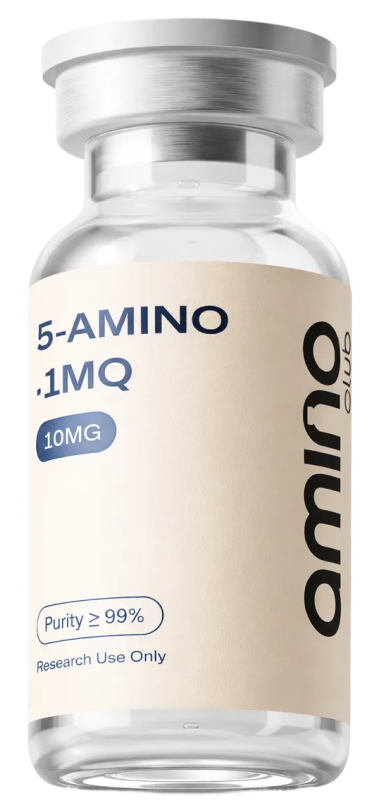
Body Recomposition Compound
A selective small-molecule inhibitor of nicotinamide N-methyltransferase (NNMT) that modulates NAD+ salvage and lipogenesis pathways in preclinical metabolic research models. Premium Research Peptide.
5.1%
Body Weight Loss
DIO mice, 11 days
50%
Fat Reduction
Adipocyte lipogenesis
38.4%
Oral Bioavail.
Rat PK study
1.6×
NAD+ Increase
Intracellular levels
2×
Muscle Fiber Size
Aged mice regeneration
5-Amino-1MQ is a selective inhibitor of NNMT — an enzyme overexpressed in fat tissue that depletes NAD+ and promotes fat storage. By blocking NNMT, the compound preserves NAD+ for energy metabolism and suppresses new fat formation, without affecting appetite or food intake.
Nicotinamide N-Methyltransferase
Blocks fat-promoting enzyme
Preserves NAD+ levels
Conserves SAM methyl donor
Nicotinamide Adenine Dinucleotide
Increases cellular energy currency
Enhances mitochondrial function
Supports metabolic flexibility
Ornithine Decarboxylase / Spermidine-Spermine Acetyltransferase
Increases energy expenditure
Enhances thermogenesis
Drives metabolic rate
NNMT is overexpressed in the fat tissue of obese individuals. It consumes nicotinamide (vitamin B3) and the universal methyl donor SAM, simultaneously depleting NAD+ and altering gene regulation in ways that promote fat storage.
Selectivity: 5-Amino-1MQ inhibits NNMT with an IC50 of ~1.2 μM while showing zero activity against DNMT1, PRMT3, COMT, NAMPT, or SIRT1 at concentrations above 100 μM — confirming highly targeted action.
Unlike GLP-1 agonists (semaglutide, tirzepatide) which primarily reduce food intake, 5-Amino-1MQ drives weight loss through increased metabolic expenditure. In animal studies, treated mice lost weight while eating the same amount as controls.
Key distinction: Food intake was not significantly different between treated and control groups, yet treated mice lost 5.1% body weight while controls gained 1.4% — confirming a purely metabolic mechanism.
Summary of preclinical findings
Reduction in White Adipose Tissue Mass
Study details: Diet-induced obese mice received 20 mg/kg subcutaneously 3× daily for 11 days. Treated mice lost 5.1% body weight while controls gained 1.4%, with no difference in food intake between groups.
Data from diet-induced obesity mouse model
Important context: All data is from preclinical animal studies. No human clinical trials have been conducted. The compound is at the research stage only.
Note: Combined NNMTi + diet switch produced a 10-fold greater fat mass reduction compared to diet switch alone, normalizing body composition to match lean controls.
Extended treatment demonstrated dose-dependent metabolic improvements across multiple endpoints.
Other benefits observed in research
Increased intracellular NAD+ availability
Neelakantan et al., 2017Improved muscle function in aged mice
Neelakantan et al., 2019Reduced plasma total cholesterol
Neelakantan et al., 2018Viable oral dosing confirmed in rats
Awosemo et al., 2021NNMT inhibition activated senescent muscle stem cells in aged mice, improving the regenerative capacity of skeletal muscle.
Research finding: Treatment produced nearly two-fold greater cross-sectional area of regenerating muscle fibers, demonstrating rejuvenating effects on aged muscle tissue.
Extended NNMT inhibition attenuated fatty liver disease markers and normalized liver enzymes in obese mice.
Combined NNMT inhibition with dietary changes produced a distinct beneficial gut microbiome signature.
An independent study found 5-Amino-1MQ showed selective anti-proliferative activity against HeLa cancer cells while sparing normal cells.
Inhibits cancer cells, spares normal HEK-293 cells
Early-stage finding: Concentration- and time-dependent inhibition of HeLa cell proliferation with morphological signs of apoptosis, decreased phospho-Akt and SIRT1. Independent replication needed.
What preclinical studies report
5-Amino-1MQ has shown a favorable preclinical safety profile. All data comes from cell culture and animal studies — no human safety data exists.
5-Amino-1MQ demonstrates remarkable selectivity for NNMT with no off-target enzyme inhibition:
Cytotoxicity threshold at ~600 μM — far above therapeutic range
No adverse effects at doses up to 60 mg/kg/day in mice
No genotoxicity detected in standard battery of assays
Not FDA-approved for any indication
Not registered on ClinicalTrials.gov
Classified as a research chemical only
No Investigational New Drug (IND) application publicly reported
Technical specifications
Common questions about 5-Amino-1MQ research
5-Amino-1MQ is a small molecule inhibitor of nicotinamide N-methyltransferase (NNMT), an enzyme overexpressed in the fat tissue of obese individuals. NNMT depletes both NAD+ and SAM (the universal methyl donor), promoting fat storage. By selectively blocking NNMT with an IC50 of ~1.2 μM, 5-Amino-1MQ preserves NAD+ for energy metabolism and suppresses lipogenesis (fat creation). Unlike GLP-1 receptor agonists, it works through metabolic pathways rather than appetite suppression.
No. 5-Amino-1MQ is a small molecule quinolinium derivative, not a peptide. It has a molecular weight of just 159.21 g/mol (compared to thousands for peptides). However, it is commonly researched alongside peptide-based metabolic compounds due to its complementary mechanism of action targeting the NAD+/NNMT axis.
In diet-induced obese mice, 11 days of treatment produced 5.1% body weight loss (vs 1.4% gain in controls), 35% reduction in white adipose tissue, and 30% reduction in cholesterol — all without affecting food intake. A 2024 study confirmed dose-dependent improvements in glucose tolerance, insulin sensitivity, and hepatic steatosis over 28 days. Separately, treatment in aged mice nearly doubled regenerating muscle fiber size and improved muscle strength by ~70%.
Pharmacokinetic studies in rats demonstrated 38.4% oral bioavailability with an oral half-life of 6.9 hours and peak plasma concentration of 2,252 ng/mL. High passive membrane permeability and minimal efflux support oral administration viability. However, no human oral dosing has been studied.
Preclinical data is favorable: no cytotoxicity up to 100 μM in cell culture, no genotoxicity in standard assays, and no adverse effects at 60 mg/kg/day for up to 28 days in mice. The compound is highly selective for NNMT with no off-target inhibition of related enzymes. However, no human safety data exists as no clinical trials have been conducted.
They work through completely different mechanisms. GLP-1 agonists (semaglutide, tirzepatide) primarily suppress appetite through receptor activation, while 5-Amino-1MQ increases metabolic expenditure through NNMT inhibition without affecting food intake. GLP-1 drugs are FDA-approved with extensive human clinical trial data. 5-Amino-1MQ remains preclinical with animal data only. They target different pathways and could theoretically complement each other, though combination studies have not been conducted.
5-Amino-1MQ is not approved for human use by the FDA or any regulatory authority. No clinical trials are registered on ClinicalTrials.gov, and no IND application has been publicly reported. All research originates primarily from the Watowich/Neelakantan laboratory at the University of Texas Medical Branch. It is classified as a research chemical only.
Peer-reviewed research
Neelakantan H, Wang HY, Vance V et al.
Neelakantan H, Vance V, Wetzel MD et al.
Neelakantan H, Brightwell CR, Graber TG et al.
Sampson CM, Dimet AL, Neelakantan H et al.
Awosemo O, Neelakantan H, Watowich S et al.
Akar S, Duran T, Azzawri AA et al.
Dimet-Wiley A, Wu Q, Wiley JT et al.
Babula JJ, Bui D, Stevenson HL et al.
Not for human consumption. This product is sold exclusively for research and educational purposes. It is not intended to diagnose, treat, cure, or prevent any disease.
All clinical trial data and research findings presented on this page are sourced from peer-reviewed journals and official publications. They are provided for educational reference only and should not be interpreted as medical advice or product claims.
By purchasing this product, you confirm that you are a qualified researcher and will use it in accordance with all applicable laws and regulations.
Metabolic & NAD+ pathway compounds